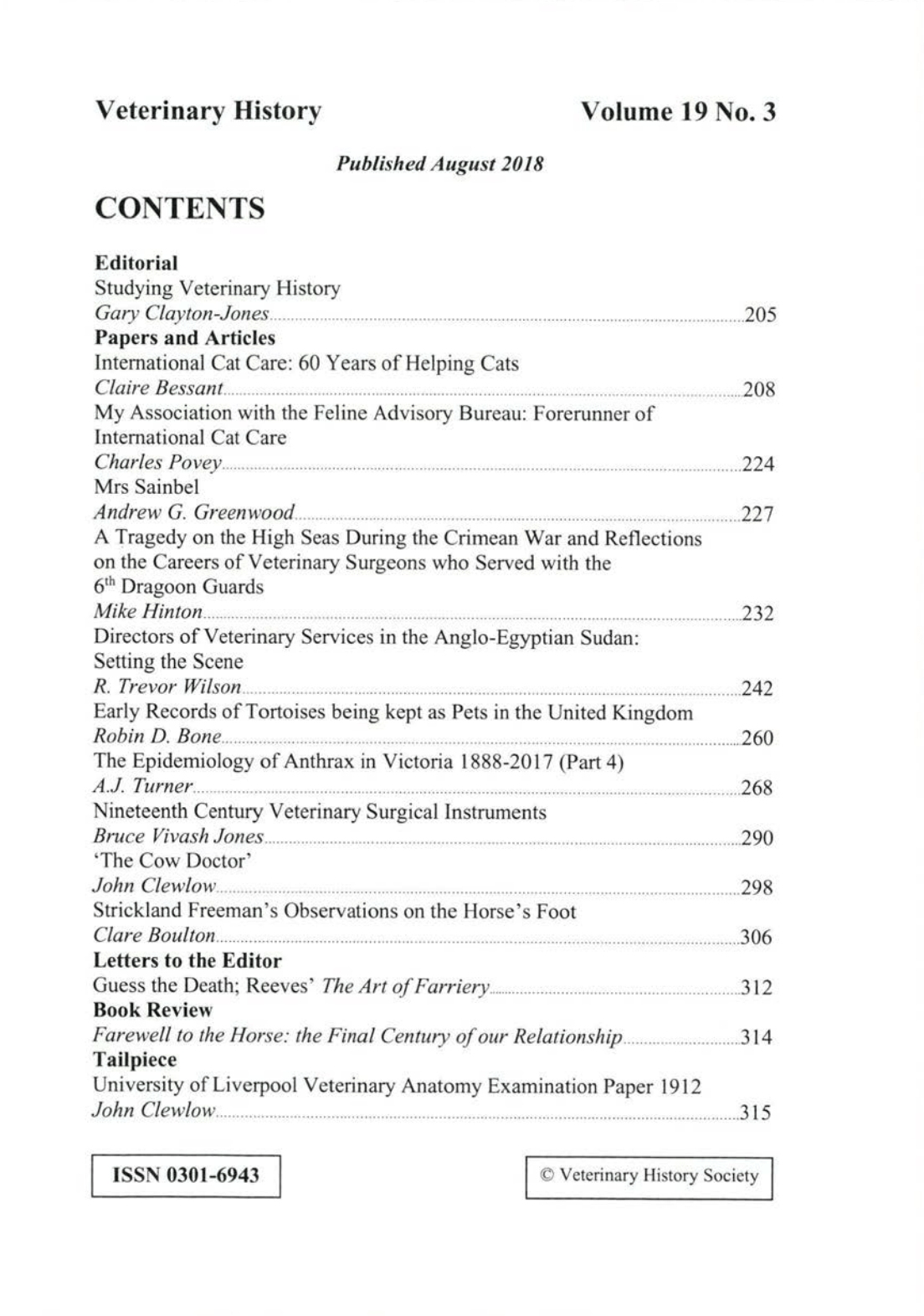
International Cat Care: 60 Years of Helping Cats
Reflecting on 60 years since the founding of the Feline Advisory Bureau (FAB), the article reviews development into the field of feline veterinary medicine. The driving force was Joan Judd, who was instrumental in the development of the organisation. Early areas of focus were viral disease, nutrition, husbandry and poisoning. The 1970s saw a significant restructuring of the charity. Continued expansion, despite some financial difficulties along the way led to a name change in 2012 to International Cat Care and every increasing international links.
Claire Bessant
My Association with the Feline Advisory Bureau: Forerunner of International Cat Care
Commencing association with the FAB in 1967, the author details his subsequent career in the field. Early on there was a paucity of knowledge about feline infectious diseases, many common viral conditions had yet to be recognised. The author was instrumental in early reorganisation of the charity, with the inauguration of the FAB Scholarship. In 1974, the author departed to Guelph.
Charles Povey
Mrs Sainbel
Charles Sainbel first visited England in June 1788. After an apparent whirlwind romance he married Miss Anne Louis Sauer on 22 July 1788 at the German Chapel in St James Parish, London. The marriage was witnessed by her father, Henry Sauer, of Great Jermyn Street, a ‘peruke maker.’ The marriage was expedited by Sainbel as he guaranteed a marriage bond for £200, to avoid the need to read the banns of marriage. The marriage was short lived, Charles died five years later and his funeral was held in the German Chapel of the Savoy on his widow’s instructions.
Andrew G Greenwood
A Tragedy on the High Seas during the Crimean War and Reflections on the Careers of Veterinary Surgeons Who served with the 6th Dragoon Guards.
In May 1854 the Europa sailing transport was badly damaged by fire as she sailed to Turkey. Over 50 horses were lost, along with the commanding officer of the 6th (Inniskilling) Dragoon Guards, Willoughby Willoughby Moore, and the regiment’s veterinary surgeon, Richard Kelly. Moore’s widow, Charlotte, died the following year at Scutari. The paper details the veterinary surgeons who served with the regiment during the Crimean war, and their subsequent careers.
Mike Hinton
Directors of Veterinary Services in the Anglo-Egyptian Sudan: Setting the Scene
Between 1902 and 1956 12 men served as either Principal Veterinary Officers or Director of Veterinary Services in Sudan. Many had previously served with the Army Veterinary Corps, in a number of theatres of operation, and were honoured with a range of chivalry and gallantry medals.
Veterinary services had a significant focus on cattle and cattle diseases, with the cattle trade from the Sudan often supplying meat for overseas military campaigns. With time, there was increasing focus on sheep.
The paper concludes with a post-script on the development of veterinary services in the Sudan, post-independence.
R Trevor Wilson
Early Records of Tortoises Being Kept as Pets in the United Kingdom
Although tortoises became very popular as pets in the UK from the latter half of 19th century, there are several earlier reports of them being maintained as pets. The earliest account of a pet tortoise, in 1628, was that belonging to William Laud, a future Archbishop of Canterbury. Gilbert White (1720-93) owned a tortoise and was the first person to describe their natural behaviour. By the mid 20thCentury, hundreds of thousands of tortoises were imported each year, prior to the trade being banned in 1984.
Epidemiology of Anthrax in Victoria 1888-2017
Anthrax was first recorded in Victoria, Australia in 1876, and has been a notifiable disease since then. This paper details the epidemiology of the disease, and reports that outbreaks appear to be non-seasonal, and have been recorded in livestock, primarily dairy cattle, and humans. From the detailed epidemiological survey there are conclusions for both human and animal health.
A.J.Turner
Nineteenth Century Veterinary Surgical Instruments
In 1895 the Eastern Counties Veterinary Medical Society (ECVMS) purchased a collection of veterinary instruments from Arnold and Son, which available for members to borrow. The collection included dental instruments, Raymond’s Chloroform muzzle and Sandcrack instrument and clips. Two instruments are described in detail. Robertson’s Ecraseur. The ecraseur was invented by Edouard-Pierre-Marie Chassaignac (1804-79), a French surgeon. Robertson’s version could be used with a wire, rope or chain ligature. Smith’s sidebone instruments were described by Frederick Smith and used for removing enlarged side cartilages in the hoof in cases of lameness. Smith later recorded that such an operation will ‘either remove the lameness or have no effect.’
Bruce Vivash Jones
The Cow Doctor
Gifted to the author in the late 1960s, this edition of the ‘The Cow Doctor’ was published in 1858 and first owned by George Whiston. Its extended title indicates it covers a range of species, not just cattle, and also covers the brewing of ale. It is one of seven copies of the book and is now held in the Medical Sciences Library of Texas A&M. The article details the different editions of this publication.
John Clewlow
Strickland Freeman’s Observations on the Horse’s Foot
Freeman, a landowner and sporting gentleman from Buckinghamshire, published a number of works on farriery and horsemanship. In 1796 he published his Observations. Reviews were mixed, some were critical of the illustrations and the cost, whereas others were more positive, recognising his ‘attentive observation’. Frederick Smith was also critical, stating that author knew nothing of the anatomy of the horse’s foot, but did recognise the ’beautifully coloured plates’.
Clare Boulton
Please note
Buy now