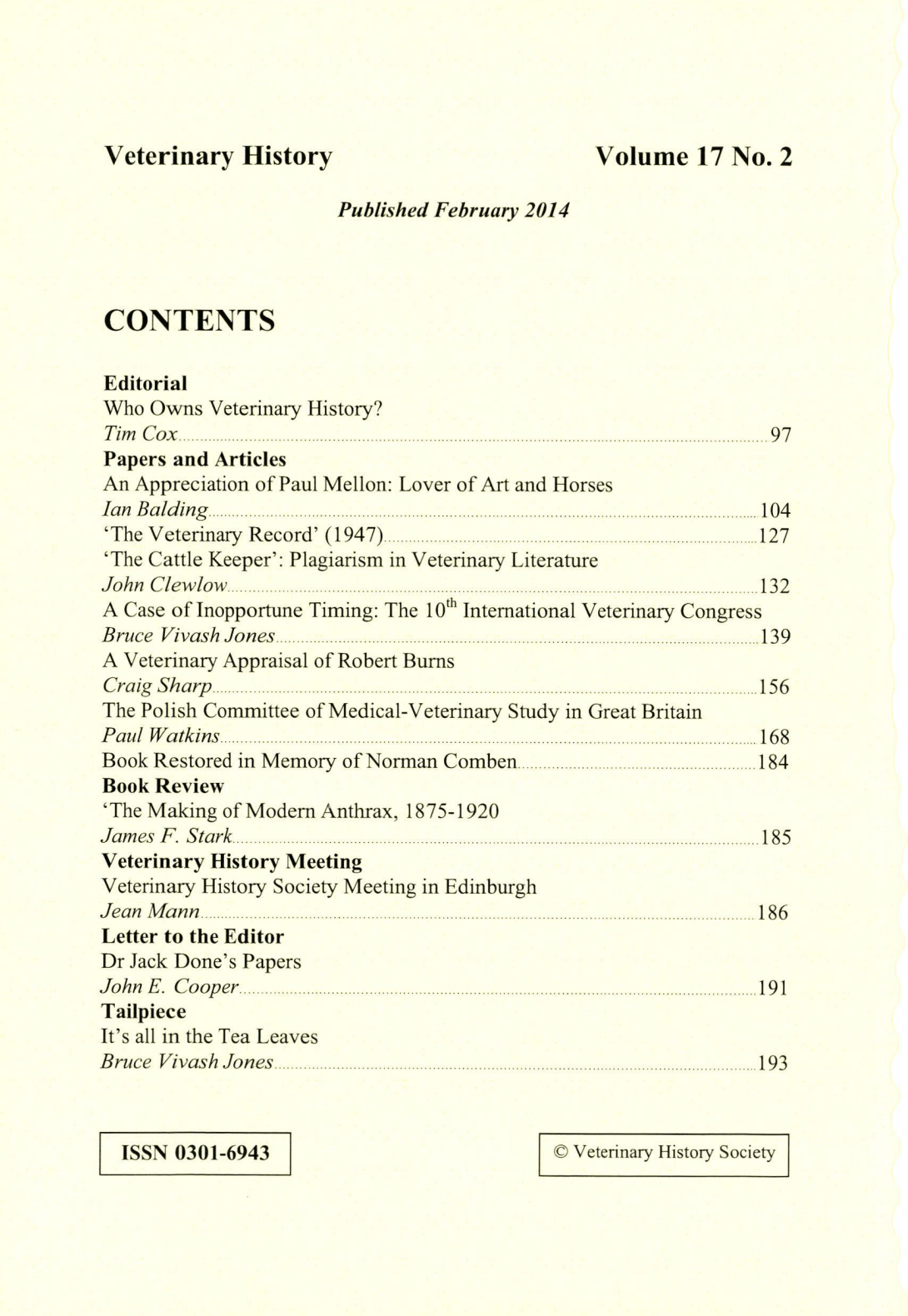
An Appreciation of Paul Mellon: Lover of Art and Horses
Paul Mellon (1907-1999) was born and raised in America, but came to Cambridge to study history. Here acquired his love of horses. He commenced his collection of sporting art, the first painting acquired being ‘Pumpkin with Stable Lad’ by George Stubbs. This article provides a detailed commentary of 10 artworks owned by Mellon.
His ownership of racehorses is also described and his involvement with the author (a trainer). This includes an in-depth report on the Derby winner, Mill Reef, including his veterinary care and the treatment of his fractured cannon bone by Jim Roberts in 1972.
Ian Balding
‘The Cattle Keeper’: Plagiarism in Veterinary Literature
Veterinary texts of the 17th, 18th and 19th Centuries were rife with plagiarism. The author traces the numerous published iterations of The Complete Cattle Keeper, from 1774 to 1840, many of which had no attributable author.
Although clearly identifying the published texts, their publishers and contents, the author is left with an abiding of question of ‘when did the original thoughts and ideas emerge?’
John Clewlow
A Case of Inopportune Timing: The 10th International Veterinary Congress
On August 4, 1914, Britain declared war on Germany, one day after the 10th International Veterinary Congress was officially opened in London.
The first International Veterinary Congress was the initiative of John Gamgee (Edinburgh) and was held in 1863. In 1909 it was proposed that the 10th Congress would be held in London; initial plans were to hold it in 1913 (50 years after the first). This was delayed a year due to a large International Medical Congress being held that year. Sir John McFadyean was chairman of the congress organising committee and led the fundraising efforts, seeking over £4000. The congress venue was to be Central Hall, Westminster.
With the assassination of Archduke Ferdinand on 28 July 1914, the clouds of war rapidly gathered over Europe. None of the intended delegates from France, German, Austria or Serbia arrived in London. Despite the global situation, the congress was officially opened on Monday 3 August. The following day, with many British delegates having been called up for military duty, the congress was closed.
Although no scientific papers were presented, the proceedings of the congress (1500 pages) were published in 1915.
Bruce Vivash Jones
A Veterinary Appraisal of Robert Burns
Robert Burns (1759-96) had a keen interest in farming and farm animals. One third of his works contain references to animals, ranging from book-worms to tigers. The author considers numerous passages from Burns, illustrating his animal connections.
Burns appears to have acquired some veterinary clinical knowledge as seen in The Auld Man’s Mare’s Dead.
Craig Sharp
The Polish Committee of Medical-Veterinary Study in Great Britain
In the autumn of 1939, attacks by Germany and Russia on Poland left thousands of Poles displaced from their country. Following the Fall of France in 1940 there were 24,000 Poles in Britain, including about 60 veterinarians.
The desire for continuing professional education led to the establishment, in 1941, of a Polish Medical School in Edinburgh, through the efforts of Professors Antoni Jurasz and Francis Crew. Amongst the staff were two Polish veterinarians.
In 1943 a Polish Veterinary School was established, co-habiting with the Royal Dick Veterinary College. It was led by Professor Stanislaw Runge, Rector of Poznan University. When opened, there was no expectation that graduates would seek to work in Britain. Classes were given both by Polish staff and those from the Royal Dick. The school closed in 1947; during its short life 63 students enrolled, of whom 23 graduated, including one woman.
The author describes in detail the stories of several students at the school, and concludes by outlining the issues and challenges faced by many of the students following the end of World War 2.
Paul Watkins
Please note
Buy now