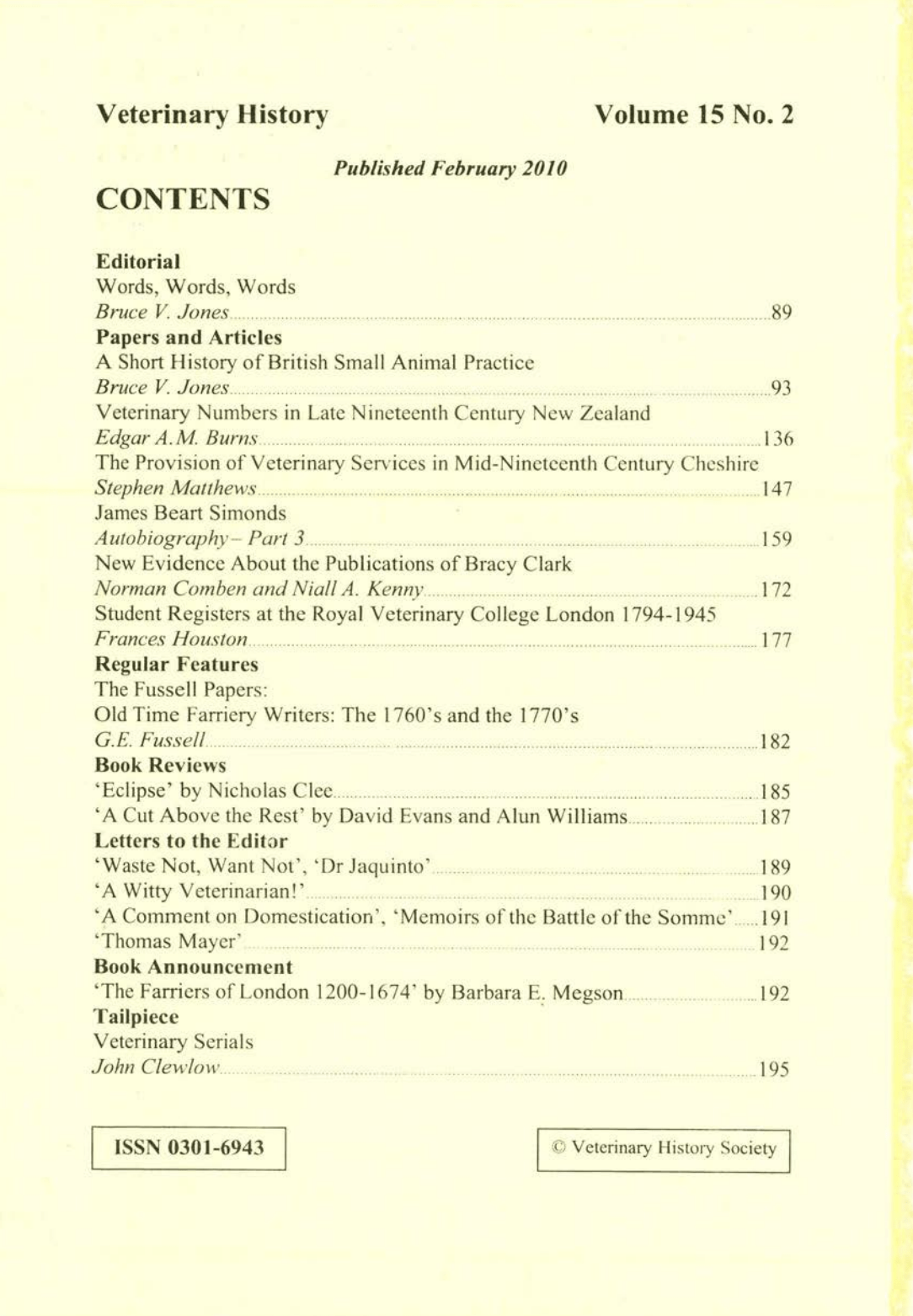
A Short History of British Small Animal Practice
A history of small animal practice in Britain, from the earliest mention of ‘British’ dogs by Roman authors to the foundation of the BSAVA in 1957. The author covers the classical and medieval periods. He reviews early veterinary literature, including John Caius, who described sixteen different types of dogs in Britain. ‘The Noble art of Venerie or Huntin’ was the first book to deal with canine disease in Britain was published in 1575. A section on Rabies describes the condition and history of attempts at treatment and control. The professional relationship between William Youatt and Delabere Pritchett Blaine is escribed and their significant influence on the development of small animal practice. In the later nineteenth century, the idea of a pet dogs as opposed to working or hunting dogs was increasingly recognised. The prominence of Edward Mayhew and his writings was important. Other important figures and their writings are considered including: T W Gowring, Finlay Dun, William J H Morton, John Woodruffe Hill, John Henry Steel and William Hunting. A brief account of Canine Distemper is given. The development of anaesthesia is owed to Frederick Hobday and James McCunn followed later by J G Wright and Madelaine Oyler. Nursing became, increasingly, important from the middle of twentieth century and a register was established in 1966. Improvements in humane euthanasia occurred over twentieth century. The foundation of the Animal Health Trust and the BSAVA are important landmarks in the development of small animal practice in the UK.
Bruce V Jones
Veterinary Numbers in Late Nineteenth Century New Zealand
The government veterinary service in New Zealand was founded in 1893. Before that there was a gradual emergence of qualified and unqualified veterinarians, but the numbers were very small with only fifty-five vets and farriers in the country in 1891 and only nine MRCVS vets are recorded as working in the late nineteenth century. The demand for veterinary services was low due to low population numbers, relative absence of disease due to geographical isolation and the low value of the livestock. Several tables of figures of veterinary surgeons and farriers from New Zealand census data are included.
Edgar A M Burns
The Provision of Veterinary Services in Mid-Nineteenth Century Rural Cheshire
An account of the changing proportions of cow leeches, unqualified ands qualified veterinary practitioners over the nineteenth century. Cheshires was primarily a cattle county and there were very few qualified vets, who had minimal training on cattle disease as the RVC course was mainly based on the horse. The status of qualified veterinary surgeons was barely higher than unqualified men and did not play a large part in the diagnosis, treatment and management of the three main cattle diseases of this time: Foot-and-Mouth Disease, Pleuropneumonia and Rinderpest. In 1873 there was a parliamentary select committee on cattle diseases. A lot of evidence was given about the peripheral role played by veterinary surgeons, due to lack of knowledge and status. Despite this the veterinary surgeon’s opinion was still regarded as definitive by courts and government agencies involved in slaughter and compensation of cattle. Local landowners appeared to be more inclined to seek qualified veterinary advice, sometimes approaching vets form outside the area, who had a good reputation.
Stephen Matthews
James Beart Simonds Autobiography – Part 3
Third part of the autobiography of James Beart Simonds. It deals with his involvement in the Sheep Pox outbreak of 1840s and in outbreaks of Pleuropneumnia and Rinderpest. He also discusses vaccination of cattle.
New Evidence about the Publications of Bracy Clark
An account of the many publications of Bracy Clark (1771-1860), one of the first men to qualify from the London Vet College.
Norman Comben and Niall A Kenny
Student Registers at The Royal Veterinary College, London 1794-1945
A short review of the student registers held by the Royal Veterinary College in London, giving examples of student origins and careers.
Frances Houston
Old Time Farriery Writers: the 1760s and the 1770s
A review of farriery writers, including Thomas Wallis, S Freeman, John Blunt, John Blount, Josiah Ringstead, William Ward, John Maple and Paulet St John
G E Fussell
Veterinary Serials
A description of four farriery books, which were originally published in instalments by G Skeavington, G Lowson, W H Rosser and W J Mills.
John Clewlow
Please note
Buy now