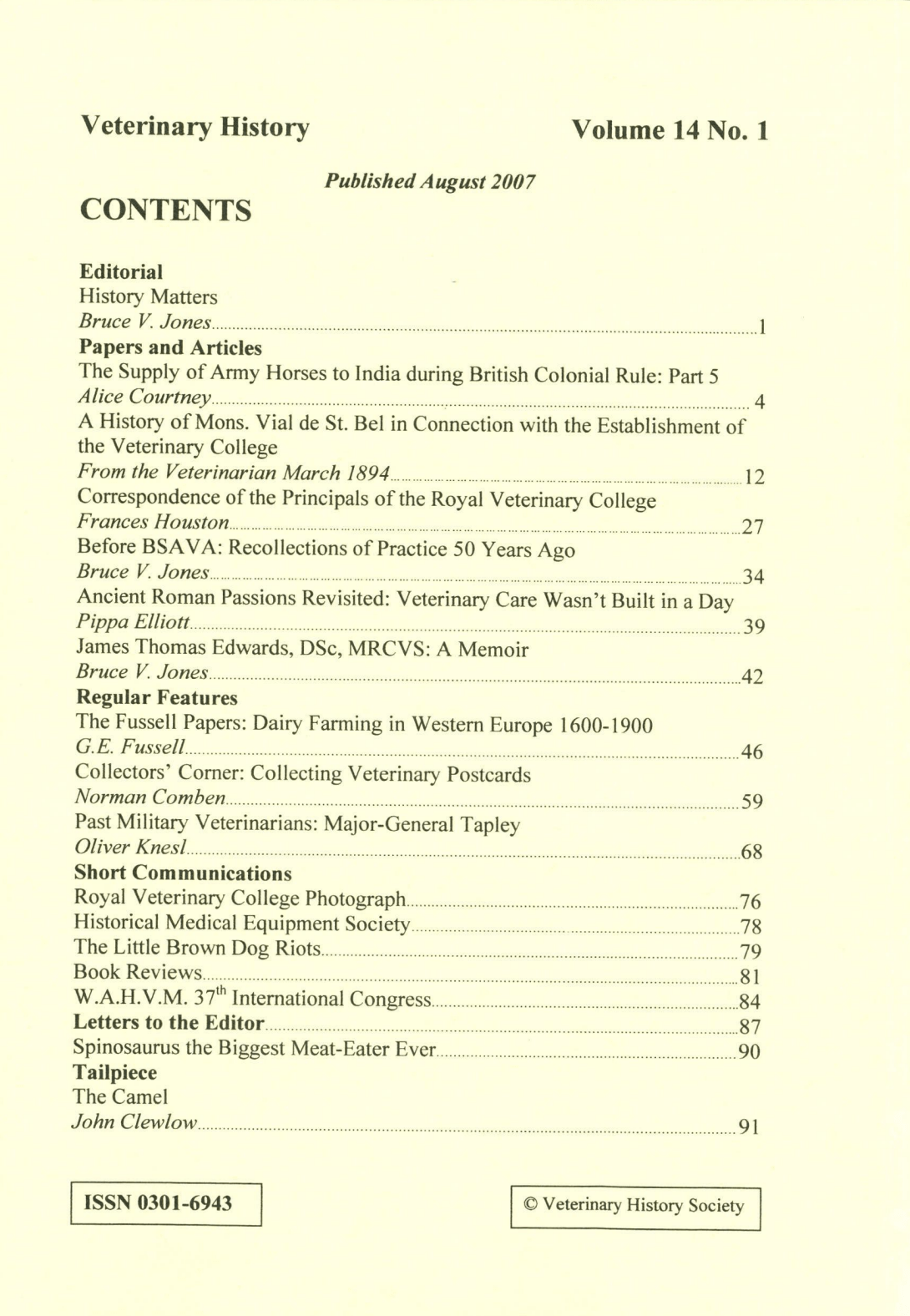
The Supply of Army Horses to India During British Colonial Rule: Importation
Fifth and final article on horse supply in colonial India. Importation had always played a major part in supplying horses for use in India by the Army. Horses were imported from various places in the early days including ‘Turkomans’ and light cavalry horses from Asia. Arabs remained the most popular imported horse, especially on the racetrack and left their mark more on Indian horses than any other breed. Importation from Australia of the ‘Waler’ started in the 1850s and became the main source of imported horses for India. The quality of the breed improving over time as the result of selective breeding in Australia. THE Old Cape Horse was another popular imported horse, especially for artillery purposes.
Alice Courtney
A History of Mons. Vial de St Bel in Connection with the Establishment of the Veterinary College
A reprint of an article first published in 1894. It covers the early life, career and death of Charles Benôit Vial de St. Bel, the first professor of the veterinary college in London. St Bel qualified as a veterinary surgeon from Lyon in France. He came to England in 1788 and was unsuccessful in forming a new veterinary school and returned to France, He returned in 1790 and produced a pamphlet about this plan to establish a veterinary school in London. This was supported by the Odiham Society of Agriculture and Industry. The Society established a fund to finance the new school and adverts were placed in many newspapers. Subscriptions flowed in and a committee, headed by the Duke of Northumberland, was established to oversee the establishment of the new veterinary school. The search for premises is described. Lectures began in January 1792 at the professor’s house. St. Bel’s untimely death in August 1793 and the problems finding a suitable replacement are outlined. John Hunter, the famous surgeon, was actively involved in the process and Edward Coleman was appointed as professor.
Reprint form the Veterinarian 1894
Correspondence of the Principals of the Royal Veterinary College, London from 1933-1953
An account of the correspondence of the two Principals of the Royal Veterinary College, Frederick Hobday and Jimmy Buxton. This covers a wide range of subjects from arrangements for the Royal visit in 1937 to trivial enquiries about a best diet for a dog or could cows catch TB from Jackdaws.
Frances Houston
Before BSAVA: Recollections of Practice 50 Years Ago
The personal reminiscences of several veterinary surgeons about small animal practice in the early 1950s. It covers: the first job and salary, starting or buying a practice, practice premises and facilities, practice turnover and profits, fee structures, daily routine, common conditions seen, main surgical procedures and medications available.
Bruce V Jones
Ancient Roman Passions Revisited: Veterinary Care Wasn’t Built in a Day
A review of the use of horses in the ancient world. Alexander the Great had 50,000 mares in his horse breeding programme. Chariot Racing was the most popular form of entertainment in the Roman world. There were four racing stables in Rome, each with their own racing colours. Veterinary care was variable and there was a general contempt for the occupation of attending to animals.
Pippa Elliott
James Thomas Edwards, DSc MRCVS: A Memoir
James Thomas Edwards was born in 1889 and qualified from the RVC IN 1911. After a short spell in practice, he was appointed to a pathology scholarship at the RVC. He investigated Johne’s Disease, Canine Distemper and Bovine Tuberculosis. He served with the RAVC during the first world war, before returning To the RVC becoming professor of veterinary hygiene. In 1921 he went to India as director of the Imperial Bacteriological Laboratory, involved with the development of a rinderpest vaccine. He returned to the UK in 1929 and devoted his time to research into Foot-and-Mouth Disease. In 1946 he went to Egypt to become Dean of a newly founded veterinary school at Giza, until 1948. He died in 1952.
Bruce V Jones
Dairy Farming in Western Europe 1600-1900
A history of dairy farming in Europe. Cows were either owned by the dairy farmer of leased out to a dairyman, with a sharing of the profits. Various breeds are described, including Shorthorns and Friesians. A major obstacle to dairy farming was lack of food over the winter and cows could be in very poor shape by the spring. Developments in fodder crops and improved grasslands helped this situation. Milk supply was limited to the local area until the advent of railways, which could bring milk into the cities from the countryside. An account t of the production of various dairy products, including cheese, butter and cream is given. Ther is an account of the average milk yields and how they increased over the years.
G E Fussell
Collecting Veterinary Postcards: or Taking Postcards Seriously
An account of postcards which show veterinary subjects. Trenton Boyd, from the University of Missouri, has a collection of 6,000 postcards showing veterinary subjects. The author looks at British postcards produced showing depictions of the RVC, Animal Welfare Charities, military and other animal related subjects.
Norman Comben
Major-General James John Bonifant Tapley, CB DSO MRCVS (1877-1958)
James John Bonifant Tapley was born in 1877 and qualified form the RVC Iin1899. He served in the Army veterinary Department during the Boer War. He returned to South Africa in 1903 to wort for Army Veterinary Service in Pretoria until 1908. He went to Egypt in 1911, before being recalled in 1914, to served in Army Veterinary Corps in 1914. He returned to Egypt in 1915 becoming Principal Veterinary Officer in the Egyptian Army. He became Director-General of the Royal Army Veterinary Corps in 1933, before retiring in 1937. He died in 1958.
Oliver Knesl
Please note
Buy now