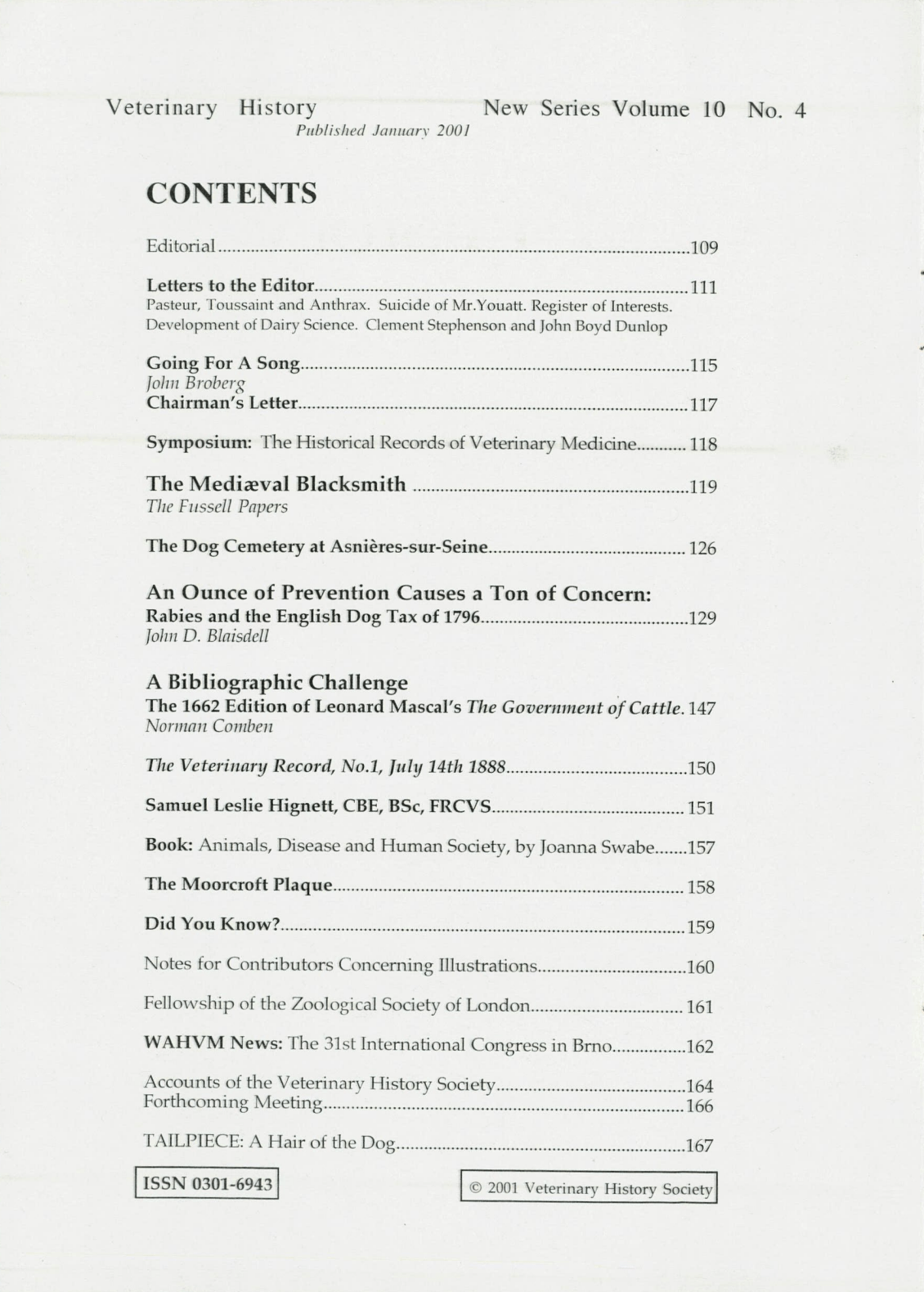
The Medieval Blacksmith, Ancestor of the Engineer
The medieval blacksmith in England was a servant of the manor, holding his land, cottage and forge on the same terms as other tenants, owing rent and services to the Lord of the Manor. A farrier in London at the site of St Clement Danes owed a rent of six horseshoes and sixty-one nails per annum as rent. Although horseshoeing was a major part of the work of most blacksmiths, specialities developed to include the manufacture of primitive firearms and armour for mounted knights.
G E Fussell
The Dog Cemetery at Asnières-sur-Seine
The first animal cemetery in the world was founded in 1899 at Asnières-sur-Seine, north-west of Paris. It was divided into four quarters to accommodate, dogs, cats, birds and other animals. By 1858 40,000 animals had been buried here, many with elaborate tombs.
Anon
An Ounce of Prevention Causes a Ton of Concern: Rabies and the English Dog Tax of 1796
Following an outbreak of Rabies in Britain in 1795, a dog tax was introduced in 1796, to make owning dogs too expensive and so limit the numbers of dogs in urban areas. It was repealed two years later, having had no effect on dog numbers. Several examples of deaths from Rabies are given. A detailed account is given of the numbers and ownership of dogs in Westminster parishes. Dogs were thought to be carriers of plague on their fur. During the 1665 outbreak a dog killer was employed by Westminster at the rate of 1d per dog, totalling more than 300 dogs. Killing dogs, which were not strays, could result in legal action by the owner, who had the option of removing their dog from London.
John D Blaisdell
A Bibliographic Challenge. The 1662 Edition of Leonard Mascal’s The Government of Cattel
Leonard Mascal’s book ‘the first book of Cattell’ was published in 1587, with three sections devoted to oxen, horses and to sheep, goats, hogs and dogs. A number of editions were published up to 1662. Examination of three copies of the 1662 edition, by the author, show they have an engraved title page, which is not included in earlier editions.
Norman Comben
Please note
Buy now