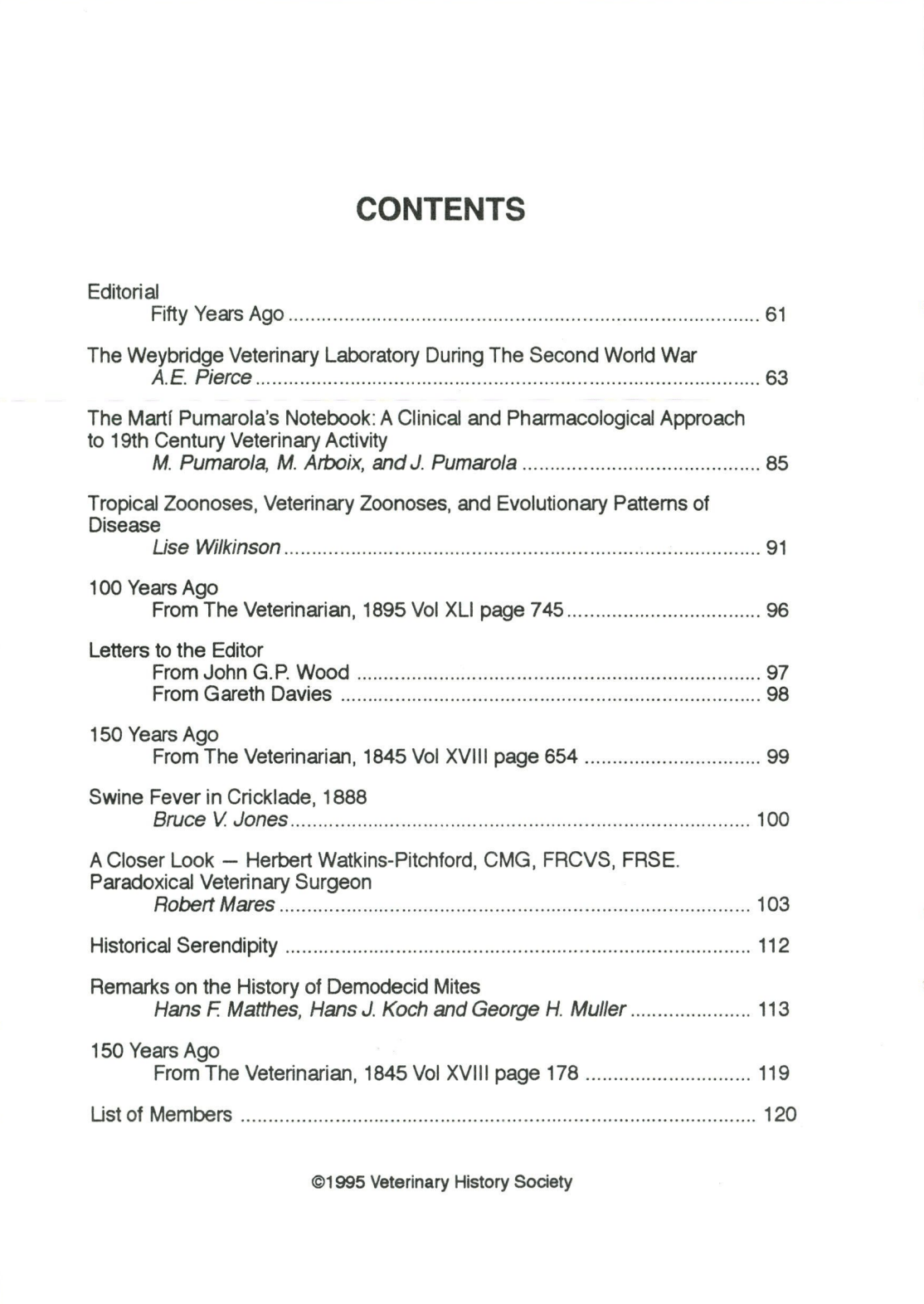
The Weybridge Veterinary Laboratory During the Second World War
A personal account of the author of working at the Weybridge Veterinary Laboratory during the Second World War. An outline of working there before the war and the staffing at the start of the war. Various bombing raids in London and near the Laboratory are described. Veterinary research carried on throughout the war, with the aim to prevent any outbreaks of any notifiable diseases. Sulphonamide drugs were becoming available and were tested for their efficacy against veterinary pathogens. During 1944 a very limited supply of a highly unstable form of penicillin became available. Investigations into developing effective carriers to overcome this problem and led to the possibility of eradication of Streptococcus agalactiae, a major cause of bovine mastitis. There was progression in the development of tuberculin for use in the testing for TB. Other investigations were carried out into Salmonellae in poultry, the production of anthrax antiserum and vaccines and Brucellosis.
A E Pierce
The Martí Pumarola’s Notebook: A clinical and Pharmacological Approach to 19th Century Veterinary Activity
Martí Pumarola was born in 1825 in the Emporodà region of Catalonia in Spain. He was described as an ‘albéitar’, an early term used before formal veterinary training was available. He wrote a notebook, signed in 1843. This contains sections on anatomy, pathology and prescriptions and cures. Examples are given of the types of prescriptions, ingredients used and several cures and remedies.
M Pumarola, M Arboix, J Pumarola
Tropical Zoonoses, Veterinary Zoonoses, and Evolutionary Patterns of Disease
An account of three major zoonotic tropical diseases – Yellow fever, Schistosomiasis and Malaria. Their life cycles, intermediate hosts and wildlife reservoirs are considered and some early attempts at control.
Lise Wilkinson
Swine Fever in Cricklade, 1888
Swine Fever was recognised as a specific disease in 1862. Outbreaks were recorded regularly after that with a particularly bad outbreak in 1878. This led to ‘The Typhoid Fever of Swine Order’. An account of Swine Fever incident in Cricklade in 1888 is described and the use of the Oreder to try and control it.
Bruce V Jones
A Closer Look Herbert Watkins-Pritchard, CMG, FRCVS, FRSE, Paradoxical Veterinary Surgeon
An account of the career of Herbert Watkins-Pritchard in South Africa from the Boer War until his resignation in 1912. Watkins-Pritchard was involved in trying to control Rinderpest (Cattle Plague), by the use of serum. He also carried out research into Horse Sickness and its association with a mosquito.
Robert Mares
Remarks on the History of Demodecid Mites
The discovery and identification of Demodex mites in man and animals is described, starting in 184, with the first publication of Demodex folliculorum. Demodex mites were found in canine skin lesion sin 1843 and by the late nineteenth century Demodex mites had been isolated from cattle, sheep, goats, pigs, deer, horse, rabbits and bats.
Hans F Matthes, Hans J Koch and George H Maller
Please note
Buy now