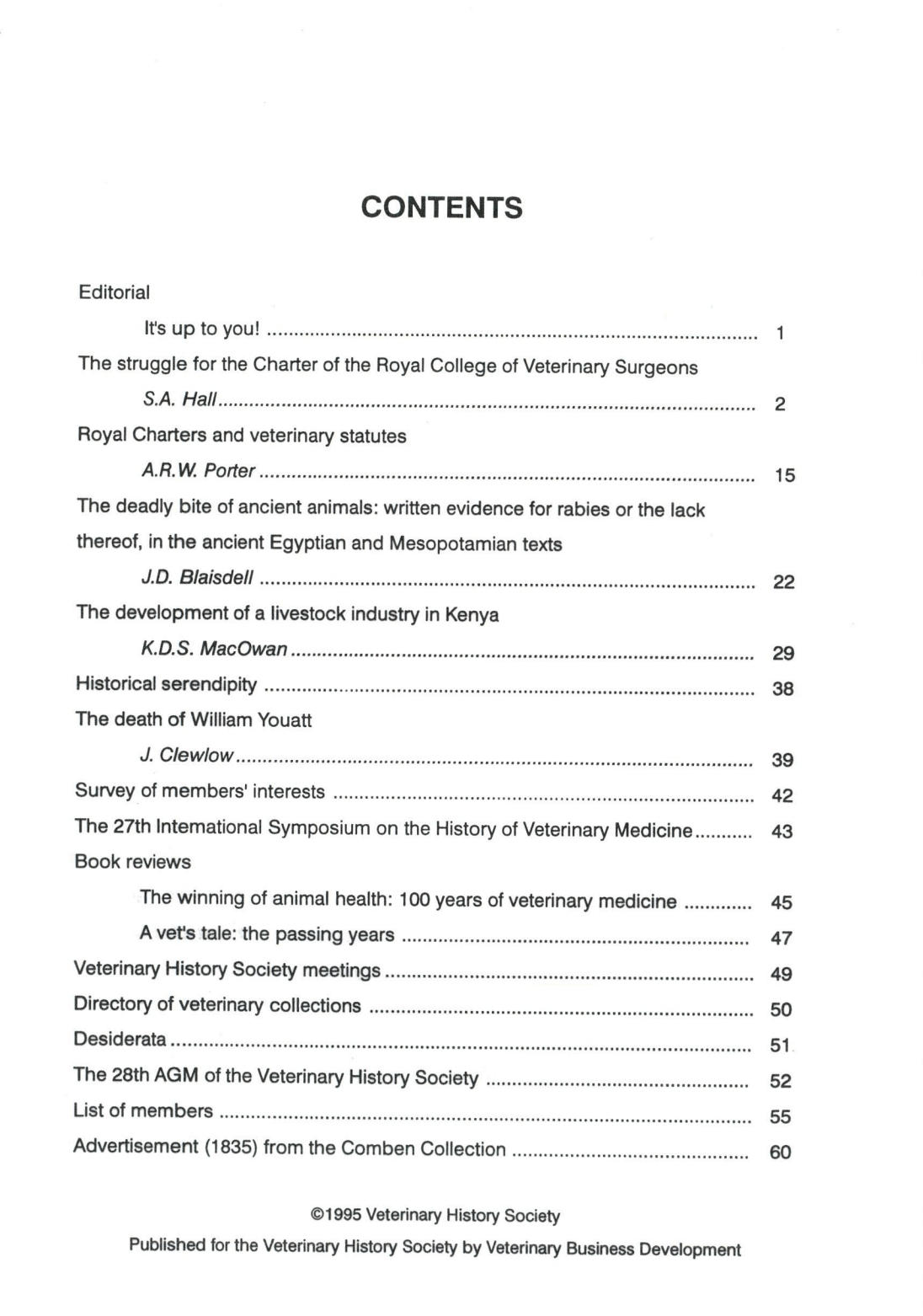
The Struggle for the Charter of the Royal College of Veterinary Surgeons, 1844
The granting of the Royal Charter in 1844 was the culmination of a long struggle to gain recognition of veterinary surgery as a profession. The struggle began in 1840 but the roots go back to the beginning of veterinary education. Edward Coleman became principal of The London Veterinary College in 1794 and remained in the post until he died in 1839. He had temporarily reduced the veterinary course from 3 years to a few months to meet the demand for army vets, but this change was not reversed. The standard of training had become very poor and focussed entirely on the horse. A major campaign in the 1820s tried to get veterinary surgeons on the examining board of the college to raise standards. Coleman died in 1839 and this allowed another campaign for improvement in training and the recognition of the profession. Thomas Mayer and his son Thomas Walton Mayer were leading campaigners. they were trying to obtain a charter similar to that granted to surgeons. This was successful in 1844. It was not until 1888 that statutory authority was given to the RCVS.
S A Hall
Royal Charters and Veterinary Statutes
A discussion of the 1844 Charter and the details of its provisions and limitations. By the 1870s the Royal College wished to make changes to the Charter. Further charters were granted in 1876 and 1879, mainly related to creation of Fellows and the holding of annual general meetings. The first Veterinary Surgeons Act was passed in 1881, which gave statutory authority to the RCVS. It was now illegal for anyone to describe themselves as a veterinary surgeon unless they were a member of the Royal College. A separate list was created for men who had been working as vets for 5 years but were not qualified –to be known as veterinary practitioners. Further charters of 1883, 1892, 1914 and 1923 were concerned with administration of the profession. The 1948 veterinary surgeons act removed the right of the RCVS to examine veterinary students. Instead, the veterinary schools would be incorporated into universities, would carry out examinations. Another act of 1966, updated some of the provisions of the 1948 act.
A R W Porter
The Deadly Bite of Ancient Animals: Written Evidence for Rabies, or the Lack Thereof, in the Ancient Egyptian and Mesopotamian Texts
The earliest reference to Rabies has often been given as from a law code dating to 2300BC. However, this seems to relate to punishments for aggression and biting of a person by a vicious dog. It is probably not related to Rabies. A papyrus dating to third century AD from Egypt does appear to describe Rabies.
J D Blaisdell
The Development of a Livestock Industry in Kenya
The livestock industry in Kenya developed very rapidly form pastoral subsistence state to commercial farming in the space of fifty years. Rinderpest and East Coast Fever were major diseases restricting expansion of livestock numbers. Vaccination and tick control programmes are described. Tsetse flies proved a difficult challenge to control. Pig production started oi the 1930s. In 1952 the African Livestock Marketing Organisation (ALMO) was founded and by the late 1950s 140, 000 head of cattle were being sold per year. Abattoirs were set up with meat inspection arrangements. A veterinary research centre and laboratory was set up at Kabete. Vaccines for more than twenty tropical diseases were developed and used. The European farmers provided essential support to the efforts to control diseases. Encouragement was given to setting up of dairies, with pasteurisation capability. Cattle breeding programmes were involved in trying to improve the productivity of local Zebu cattle by crossing with Sahiwal cattle from India. Artificial Insemination was also used to limit spread of some diseases.
K D S MacOwan
The Death of William Youatt
William Youatt was the most influential figure in the British veterinary world in first half of nineteenth century. His death and the causes are described.
John Clewlow
Please note
Buy now