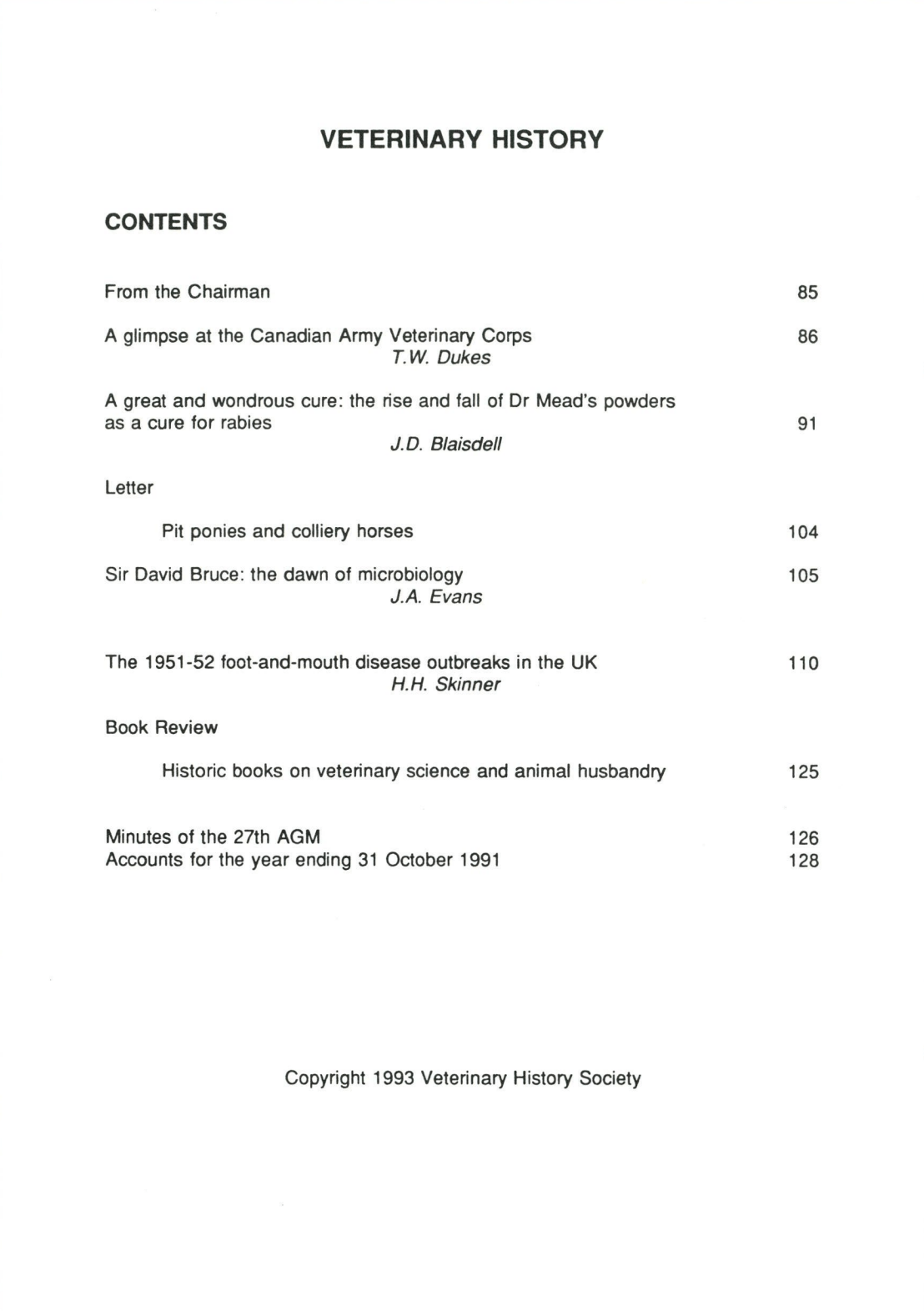
A Glimpse at the Canadian Army Veterinary Corps
The Canadian Army Veterinary Corps (CAVC/RCAVC) existed as a specific military group from 1910-1940, although there had been vets in the Canadian Army since 1872, with the first veterinary officers from 1887.The veterinary corps provided a valuable service during The Great War and ‘Royal’ was added to their title in recognition of this – RCAVC. During The Great War, there were Mobile Veterinary sections to gather ill and injured horse and deal with minor problems, more serious cases were passed on to the veterinary hospital, which had a staff of 630, including 10 veterinary officers, 33 farriers, 70 other non-commissioned officers. The RCAVC was disbanded in 1940 as the horse was no longer regarded as being of any importance to the army. Unfortunately, the lack of a veterinary unit was highlighted during the Italian campaign of 1943, when urgent assistance was requested from the British RAVC.
Thomas W Dukes
A Great and Wondrous Cure: The Rise and Fall of Dr Mead’s Powders as a Cure for Rabies
Dampier’s powders were sold, as a treatment for Rabies, from about 1670 onwards until the name changed to Dr Mead’s powders in the 1720s. They fell out of popular use by 1750s, being replaced by other, equally ineffective remedies. They were very popular remedies for the prevention of the development of symptoms of Rabies, after having been bitten by a rabid dog. Dampier’s Powders contained an extract of Lichen terrestris cinereus (liverwort) and were mainly used for dogs. Mead’s Powders were used more by people. Various other remedies were available at this time.
J D Blaisdell
Sir David Bruce: The Dawn of Microbiology
David Bruce qualified in medicine in 1881 and after a short period in general practice he joined the army and was posted to Malta. There he found many service people suffering from ‘undulant fever’. Bruce succeeded in isolating Micrococcus melitensis as the causal agent. Twenty years late hew established that the disease originated in the milk from goats. In 1920, this organism’s name was changed to Brucella. Bruce visited Koch’s laboratory, where the cause of typhoid, diphtheria and tuberculosis had been identified. Bruce set up the first bacteriology laboratory in the army medical school at Netley. He introduced the agglutination test, which helped to identify and eliminate the reservoir of Brucellosis. In Africa he was involved in research into ‘sleeping sickness’ and identified Trypanosoma brucei as a cause.
J A Evans
The 1951-52 Foot-and-Mouth Disease Outbreaks in the UK
A chronological history of the progression and control of a Foot-and -Mouth outbreak in 1951-2 in the UK. The details of the spread, public discussion, slaughter policy and government involvement are all described. The use of vaccination as a possible means of control is described.
H H Skinner
Please note
Buy now