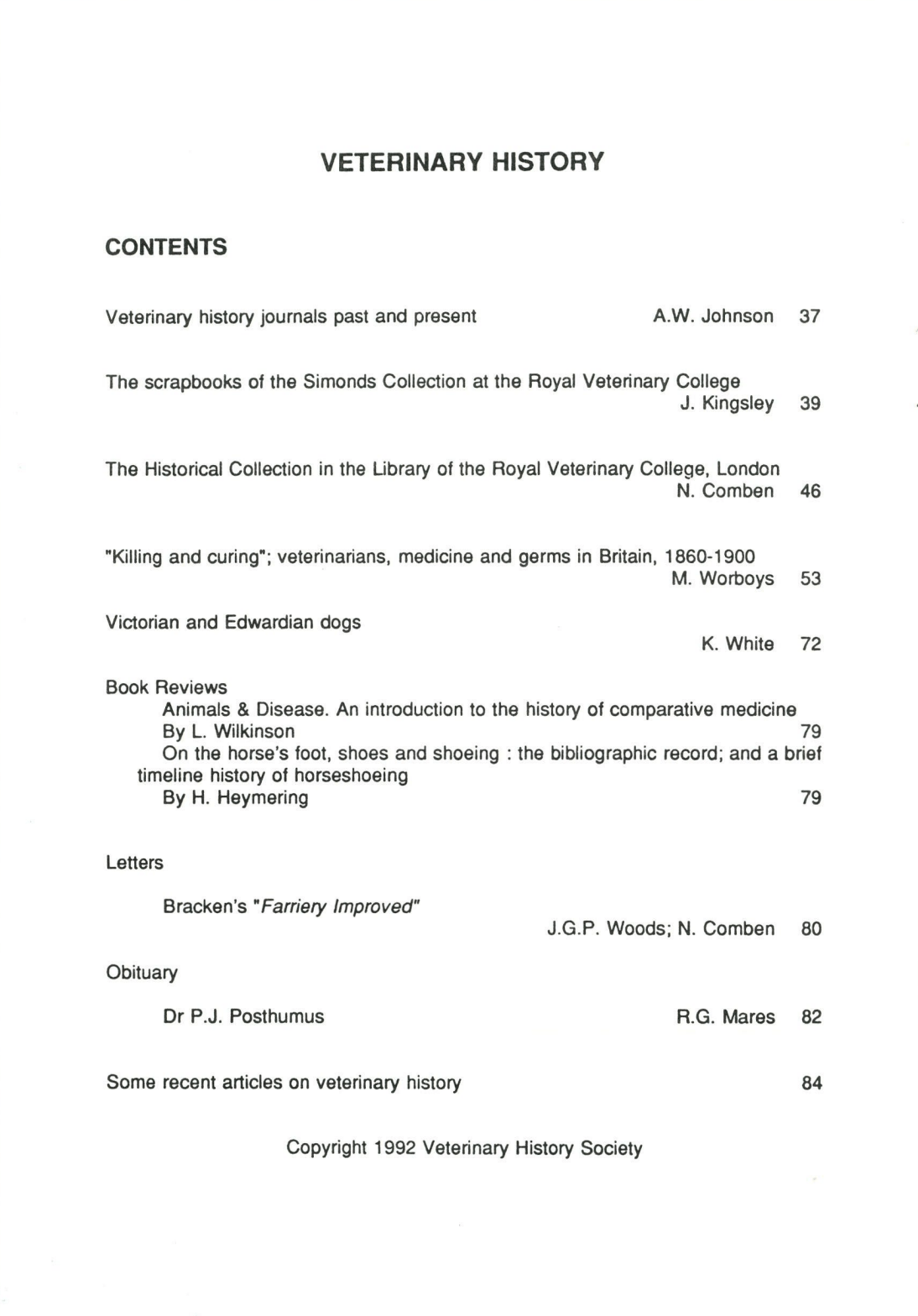
Veterinary History Journals, Past and Present
A brief review and list of journals of veterinary history published around the world, past and present.
A W Johnson
The Scrapbooks of the Simmonds Collection at the Royal Veterinary College
James Beart Simmonds was professor of cattle pathology at RVC, chief inspector and veterinary advisor to the Privy Council and president of the RCVS. He produced nine scrapbooks and many smaller bound compilations of journal reports and articles. The scrapbooks cover the period c1838 to 1896. Seven volumes are concerned with Cattle Plague (Rinderpest) containing numerous journal and newspaper cuttings, letters, tables, statistics, reports and posters. One volume is concerned with variola ovina (sheep-pox) and one volume covers the veterinary profession in general. They are of unique historical value.
Jane Kingsley
The Historical Collection in the Library of the Royal Veterinary College, London
The historical collection, which forms part of the Library of the Royal Veterinary College in London, is one of the finest and most important collections of early books on farriery and the veterinary art in the English-speaking world. It developed as the result of three very important donations, by Granville Penn of 50 volumes in 1791, a donation of the library of the Veterinary Medical association of the RVC of about 1000 volumes in the 1850s and finally a donation of the personal library of James Beart Simmonds in 1881.
Norman Comben
“Killing and Curing”; Veterinarians, Medicine and Germs in Britain, 1860-1900
The germ theory has been described as the ‘single most important concept in the history of modern medicine’. The response of the veterinary profession is discussed, focussing mainly on response to the Cattle plague epidemic of 1865. Before 1865, major livestock diseases did not feature in the consciousness of British veterinary surgeons. The island status and protectionist legislation had stopped the arrival of imported livestock diseases. The response of government and vets to epidemic are discussed. The approach of vets was towards the whole animal and to killing not curing, so were less interested in the nature and action of germs. This approach resulted in the weakness of experimental veterinary pathology before the twentieth century.
Michael Worboys
Victorian and Edwardian Dogs
At the beginning of the nineteenth century there were an estimated one million dogs in Britain. Dogs were valued for hunting, as guards, as aids to poaching, turnspits and as truffle hunters. There was a fascination in performing dogs and dogs dressed up and shown in tableaux. Dogs also suffered terrible cruelties in dog fighting and bull-baiting. Dogs were commonly used as draught animals, especially in the crowded streets of big cities. They were used to carry perishable goods and letters; often cruelly abused and left to die at the roadside of exhaustion. The use of dogs for transport was banned in 1855. The dog tax of 1865 resulted in a mass slaughtering of unwanted animals. this was the time of the animal welfare movement starting with the RSPCA and Battersea Dogs’ Home being founded. Society dogs lived a very different lifestyle, where every luxury was provided. Queen Victoria had many pet dogs and refused to have any dogs with cropped ears. Dog shows started in the 1850s.
Kay White
Please note
Buy now