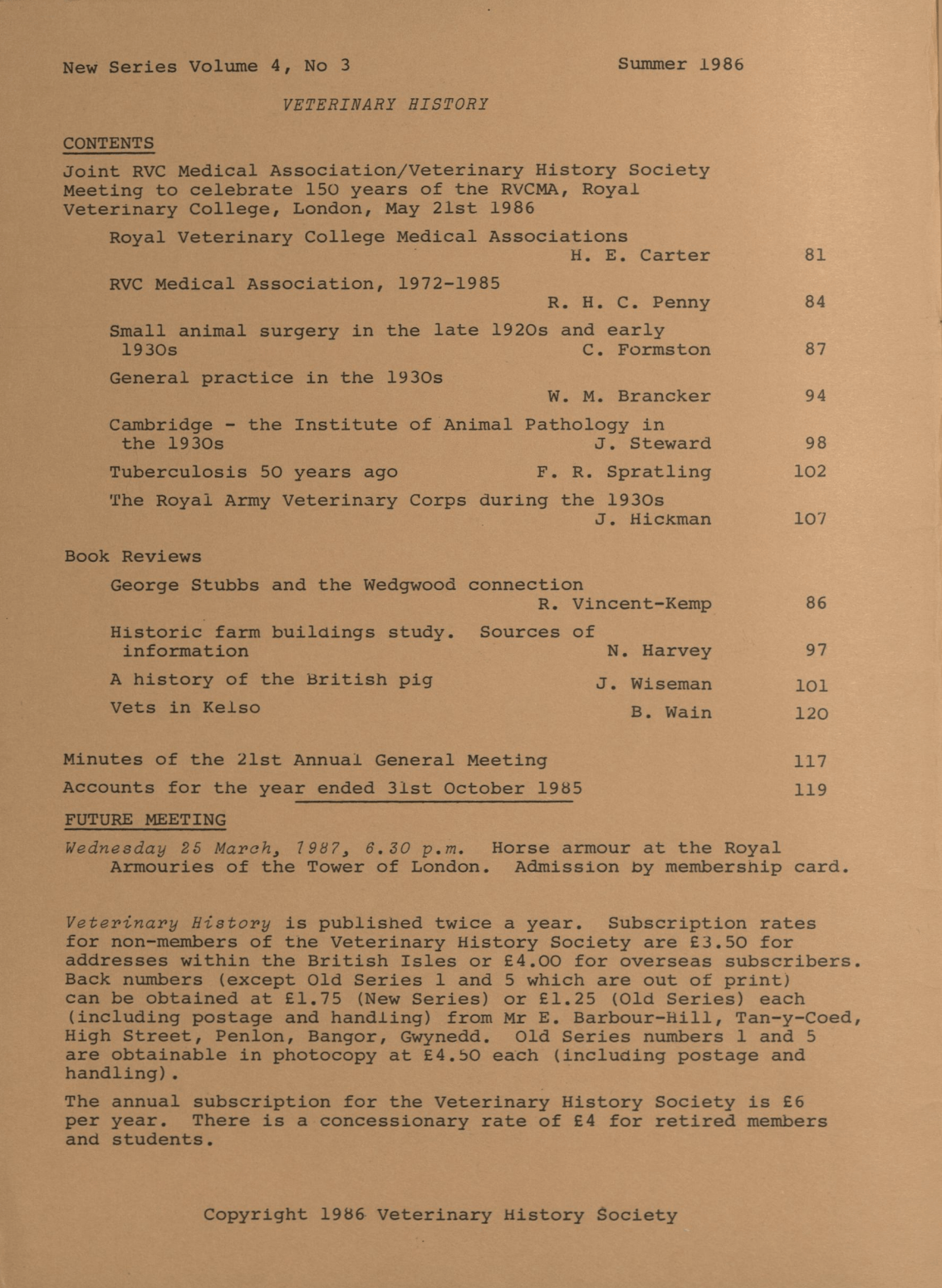
RVC Medical Association 1972-1985
The Veterinary Medical society was founded in 1836 as a meeting for vets and students, which lasted until 1881, when a new society – The Royal College Veterinary Medical Society (later Association) was formed. There was also a London Veterinary Medical society at the same time. By 1972, the RVC medical Association was in a moribund state, but by 1977 was much more active with meetings and distinguished speakers.
Professor R H C Penny
Small Animal Surgery in the Late 1920s and Early 1930s
The personal memories of Emeritus Professor Clifford Formston, who joined the staff at the RVC in 1928. This covers veterinary anaesthesia, sterilisation of instruments, surgical preparation, general surgical techniques, suture materials, and orthopaedic surgery with the early techniques being described.
Clifford Formston
General Practice in the 1930s
The personal memories of Mary Brancker, who was in veterinary general practice in Sutton Coldfield from the mid-1930s. An account of common disease affecting horses, cattle, dogs and cats and their treatments are described.
Mary Brancker
Cambridge – The Institute of Pathology in the 1930s
Personal memories of John Steward, who worked at the Institute of Pathology in Cambridge. The developments of the BCG vaccine and the intradermal skin test for TB was a major achievement. The was significant research in biochemistry and parasitology, including Onchocerca.
John Steward
Tuberculosis 50 Years Ago
The personal memories of F R Spratling of the early research into Tuberculosis in cattle. There was a lot of pathological research of diseased cattle. The development of the intradermal tests and BCG vaccine are described.
F R Spratling
The Royal Army Veterinary Corps during the 1930s
Personal memories of John Hickman. In the 1930s, there were 13,00 horses and 400 mules kept by the army in the UK. This number declined as cavalry regiments were mechanised. There were also 2000 horse stationed in Egypt. Protections for horses were developed as a response to the use of Mustard gas by the Italian army in Abyssinia. Shoeing of horses was a major responsibility and the Army School of Farriery had been established in 1915. The role of the remount department in the supply of horses is described. The work of veterinary officers in India was very varied, with many species needing attention. The RAVC was heavily involved in Waziristan Operations of 1937. The RAVC was involved in significant research with the Royall Army Veterinary School, later RAVC Laboratory.
John Hickman
Please note
Buy now